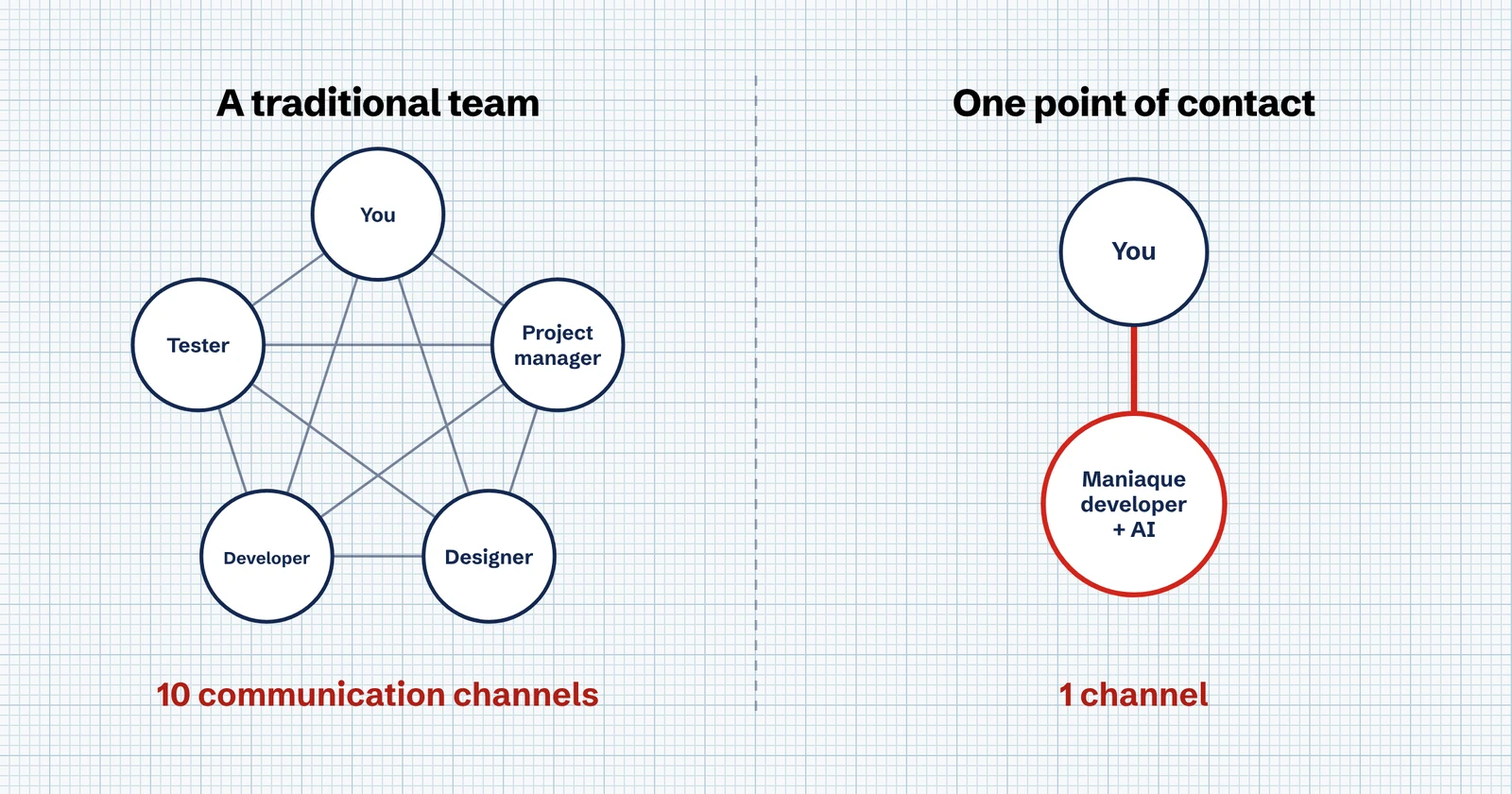
For years, building custom software meant assembling a team: a project manager, a designer, developers, a tester. AI is changing that equation. Today, one skilled person can carry a project from start to finish, and for a small business it's often the best option.
A trend you can see in the numbers
According to Carta's 2025 Solo Founders Report, the share of startups founded by a single person rose from 23.7% in 2019 to 36.3% in the first half of 2025. More than one new company in three now starts with a single founder. Carta describes AI as a "force multiplier" that lets one person prototype and launch a product far faster than before.
The Nasdaq Economic Institute, as reported by Axios, sees the same thing: in the United States, applications for one-person businesses have risen more than 20% since early 2025, while those from companies planning to hire have stayed flat. Nearly half of that growth comes from the industries that use AI the most.
Some go further. OpenAI's CEO Sam Altman predicts the first one-person company worth a billion dollars, something that would have been "unimaginable without AI".
What the tool makers say
Bubble, one of the leading visual development platforms, surveyed more than 350 of its users for its 2024 State of No-Code report. Its co-founder Josh Haas predicts that the traditional triad of designer, developer and product manager will "collapse into a single role". In the same survey, 64% of respondents think most developers will mainly work with visual tools by 2030.
The numbers are open to debate, since they come from a vendor and its own users. But the direction is clear: roles that used to be spread across several people can now be held by one.
The real cost of a team: communication
In a traditional team, your need passes from hand to hand. You explain it to a salesperson or a project manager, who translates it for a designer, who passes it on to a developer, whose work is then checked by a tester. Some meaning gets lost at every handoff, and every back-and-forth costs a meeting, an email, a few days.
This has been known for a long time. In 1975, Frederick Brooks described it in The Mythical Man-Month: every person added to a project multiplies the conversations needed. It's known as Brooks's law. With 5 people, there are 10 possible communication channels. With 10 people, there are 45.
For a large project, that structure makes sense. For a small business's internal tool, it mostly creates friction: delays, misunderstandings, and an invoice that pays for coordination as much as for the work.
What AI changes
For a long time, one person simply couldn't do it all, for lack of time. Writing the code, the tests, the documentation, preparing the screens: it took several pairs of hands.
AI now handles a large part of that production. The bottleneck is no longer writing code. It has shifted to two things AI won't do for you:
- understanding your business in depth, with its exceptions, its habits and what really matters to your teams;
- making the right technical calls: which architecture, which trade-off, what to build now and what can wait.
When both skills live in the same head, there's nothing left to translate. The person who listens to you is the one who decides and builds. They know why you're asking for a feature, not just what you're asking for. That profile, a "ninja" developer who speaks both your language and the machine's, is what AI finally makes viable for small businesses.
The limits, honestly
This model isn't magic. As an article in SelfEmployed, based on reporting by Fortune, points out, AI doesn't validate a market, set prices or choose priorities for you. Those decisions stay human, and that's exactly where the experience of the person in front of you matters.
The other fair question is depending on a single person. Good practice solves it: code and data that belong to you, documentation kept up to date, and standard tools that other developers can pick up.
Our take at Maniaque
That's exactly the model we chose: one point of contact who understands your business and builds your tool, backed by AI to move fast. Fewer middlemen, fewer meetings, and decisions made by someone who knows both your business and the technology.
If you'd like to see what it would look like for your company, book a free 45-minute audit. You'll leave with an honest opinion, even if it's that now isn't the right time.
References
- Carta, Solo Founders Report 2025, December 2025.
- Axios, Nasdaq sees AI behind solo founder boom, June 2026.
- Fortune, Sam Altman and the one-person billion-dollar company, February 2024.
- Bubble, The 2024 State of No-Code, 2024.
- Wikipedia, Brooks's law, after Frederick Brooks, The Mythical Man-Month, 1975.
- SelfEmployed, Solo Founders Lean On AI To Replace Teams, But Limits Remain, May 2026.